https://er.educause.edu/articles/2007/8/my-computer-romance
Years ago, a good friend wrote this essay titled “My Computer Romance.” It was a eloquent reflection on a moment in academic life when the internet—still young, still full of promise—was beginning to reshape how we learned, taught, and connected. The technologies of that era were wikis and blogs, not large language models. But the core insight still rings true, and perhaps even louder today.
“Faculty must move forward before the professional infrastructure is completely hospitable,” the essay warned. It was a call to risk, to engage with emerging tools not because they were perfect, but because they were alive—dynamic, full of possibility, and inseparable from the world our students were already inhabiting. These tools, it said, were essential components of every aspect of our lives, and only when students saw our learning blossom within a “computer romance” would they be moved to listen, to learn, and to create more wisely themselves.
That was written in 2007.
Now, in 2025, we find ourselves at the edge of something even more profound. Generative AI is not simply another tool—it is a collaborator, a mirror, a provocateur. It completes our sentences, reshapes our arguments, and sometimes sees things we’ve missed. Sometimes it makes stuff up. Embedded in its trillions of parameters, thousands of layers of artificial neutrons and the intricacies of vector calculus, may be a whole new way of understanding of language and its impact on learning.
And once again, many faculty stand back, waiting for the infrastructure to catch up—for clarity, for policy, for training. But the insight from “My Computer Romance” remains: we can’t afford to wait.
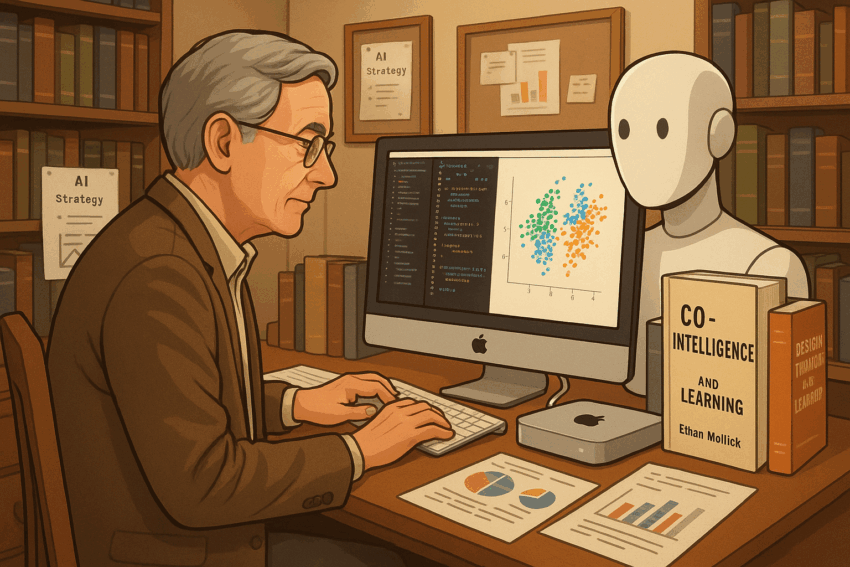
At my advanced age, I find myself writing a bit of a romance myself while remembering some of my most mundane or profound experiences with technology.(1) I was trying to articulate the sensation I had years ago while rotating a 3D graph during cluster analysis—a vivid, tactile moment when hidden patterns snapped into view only after a ninety-degree shift. I remembered the wonder of that rotation, the way the graph itself seemed to teach me something I hadn’t known how to ask. I wanted to capture that experience, but I wasn’t sure how. So I asked a question: “I don’t have access to JMP anymore. Are there other ways I could reproduce that experience?”
That simple prompt opened a new window—not just into updated software tools, but into a larger narrative of what it means to learn alongside an AI. My co-writer didn’t just answer. It walked with me. It offered code, suggested tools, explained the steps, helped me troubleshoot. It remembered that I had experience with R and was now learning Python. It recalled that I had a deep interest in reflection, a commitment to helping students think critically, and a working style that values structure, clarity, and iteration. In a few minutes, I could write enough computer code to revisit that experience of building my first 3-D model.
Every answer wasn’t just a solution—it was an invitation: Would you like a visual companion for this? A metaphor for your blog? A version tailored to faculty development or The Chronicle?
And in those moments, I saw something essential. The AI wasn’t just helping me write better—it was helping me think better. Not by replacing my thought, but by deepening it. Challenging me. Nudging me to go further, ask more, draw connections I might have missed. This wasn’t a shortcut. It was an accelerant. And like all good collaborators, it made the work feel more mine, not less.
That is the romance now.
It’s not about machines replacing human writing–any more than XYWrite, Wordstar or Note Bene did. It’s about rediscovering the joy of learning, the excitement of articulation, and the daring act of showing our students that we are still learning too. We do not know where this path leads, but we know it’s ours to walk. And we know we must walk it with our students—not behind them, not ahead of them, but beside them. As one of our marketing colleagues expressed it, “we want to be on the same side of the table with our students.”
In this new age of co-intelligence, the computers are still us. And the world—more than ever—is our wiki.
- In modern literature . . . [romance] denotes a work of prose fiction in which the scenes and incidents are more or less removed from common life and are surrounded by a halo of mystery, an atmosphere of strangeness and adventure. —William Rose Benét, The Reader’s Encyclopedia, second edition (1965)
- Much of this post was co-written by me and my ChatGPT colleague. How much? I don’t really know. We’ve had so many conversations in recent months that our perceptions have blended. I pasted the text into Grammarly, and it said that 18% was AI generated. I can guarantee that it is WAY more than that. So much for plagiarism detectors!
